
What folding a Hakama taught me about getting ‘hooked’ by the stories our minds tell us
It really feels like a previous life now, but I used to practice Aikido, a Japanese martial art centered on harmony and self-defense. It was a period of valuable personal growth where I met incredible people who shaped my journey. Even though I no longer step onto the tatami, I believe you remain an Aikidoka for a lifetime.
⬡ The Honor of the Folds
In Aikido, once you reach a certain level of skill (usually 2nd Kyu), you earn the right to wear a Hakama. It is a traditional garment - wide-legged, dark, and filled with deep, symbolic pleats. (In the photo attached to my post, you can see me wearing one).
But the Hakama isn’t just a uniform; it’s also a responsibility. After every practice (keiko), you should fold it, and do it carefully. If you do it well, the folds stay sharp and the garment maintains its dignity. If you are rushed or careless - or worse, just roll it up and stuff it back into your backpack - it loses its shape.
Secretly, practitioners often judge each other by the state of their Hakama. A faded, washed-out color is fine; it shows wear and tear due to years of hard work. But messy folds might tell a different story about the owner’s character.
⬡ The Trap our mind unintentionally sets (Cognitive Fusion)
Only after a while did I realize what the struggle with folding a Hakama truly stood for. I finally understood how much my internal 'weather' could impact me, pull me in, and drag me along through my fusion with my thoughts.
If I was upset, felt I hadn't performed well, or was frustrated by a mistake during the day at work or during practice, the folding process became a frustrating struggle. In those moments, I believed a "bad fold" was proof that I had done something wrong, and it weighed on me for the rest of the day.
I wasn't just having a thought of failure or a story in my mind about being a 'bad person'; I was fused with it. My mind was telling me a story of 'not being good enough', and I was believing it.
⬡ The Metaphor
To be clear about my (somewhat lengthy) metaphor: folding the Hakama represents the intentional process of living. The quality and care in each fold are the values I choose to live by. My struggle with the fabric represents cognitive fusion—those entangling, difficult thoughts that create obstacles, pulling me away from the purposeful, value-driven life I am trying to 'fold' for myself.
⬡ The Science of "Unhooking"
In Acceptance and Commitment Therapy (ACT), cognitive fusion happens when we get so tangled in our thoughts and moods that we start to believe they are the absolute truth of who we are. What’s more—it doesn't necessarily matter if what our mind tells us is "true" or not. The problem is that it can entangle us and pull us away from the important things in life.
These days I don't wear my Hakama anymore (it sits nicely folded in my closet), but the human mind doesn't change its habits that easily. Every now and then, I still hear those same judgmental stories of 'not good enough' creeping in when I roll up my mat after a yoga class.
What’s the difference now? I know the purpose they serve and I have (ACT) tools to deal with them.
I recognize them for what they are: just stories in my mind, a string of words. This judgmental mechanism might have served a purpose once, but now I practice 'unhooking' from my thoughts and judgments. I take the message, accept the experience for what it is, and move on to the things in life I find truly important.
⬡ Finding Your Path at self-ACTivate
I’m pretty sure that thoughts will show up in your mind, telling you this will not work. That’s natural. Your mind is there to protect your time and energy, but it doesn’t always work in your favour.
So I would love for you to try something anyway and make it fit your own style and preferences. There are so many ways to make the practice of ‘defusion’ your own.
Try taking the smallest step possible and treat it as a practice of self-compassion.
To give it a go, slow down and notice that ‘inner critic’s’ voice popping up in your mind from time to time. I know you have one, we all have.
No need to do anything with it, just learn to notice it consciously. Let it be for now.
I’m curious what you noticed and if you experienced it differently than before. Leave some thoughts in the comments or send me a message if this mini-practice resonated with you.
Acceptance and Commitment Therapy has so many more helpful tools that teach how not to let the obstacles of daily life define our paths.
If you are at a crossroads or looking for ways to navigate life's challenges with more compassion, make sure to sign up to the newsletter here.
Till next time.
Stay rooted,
Dominika
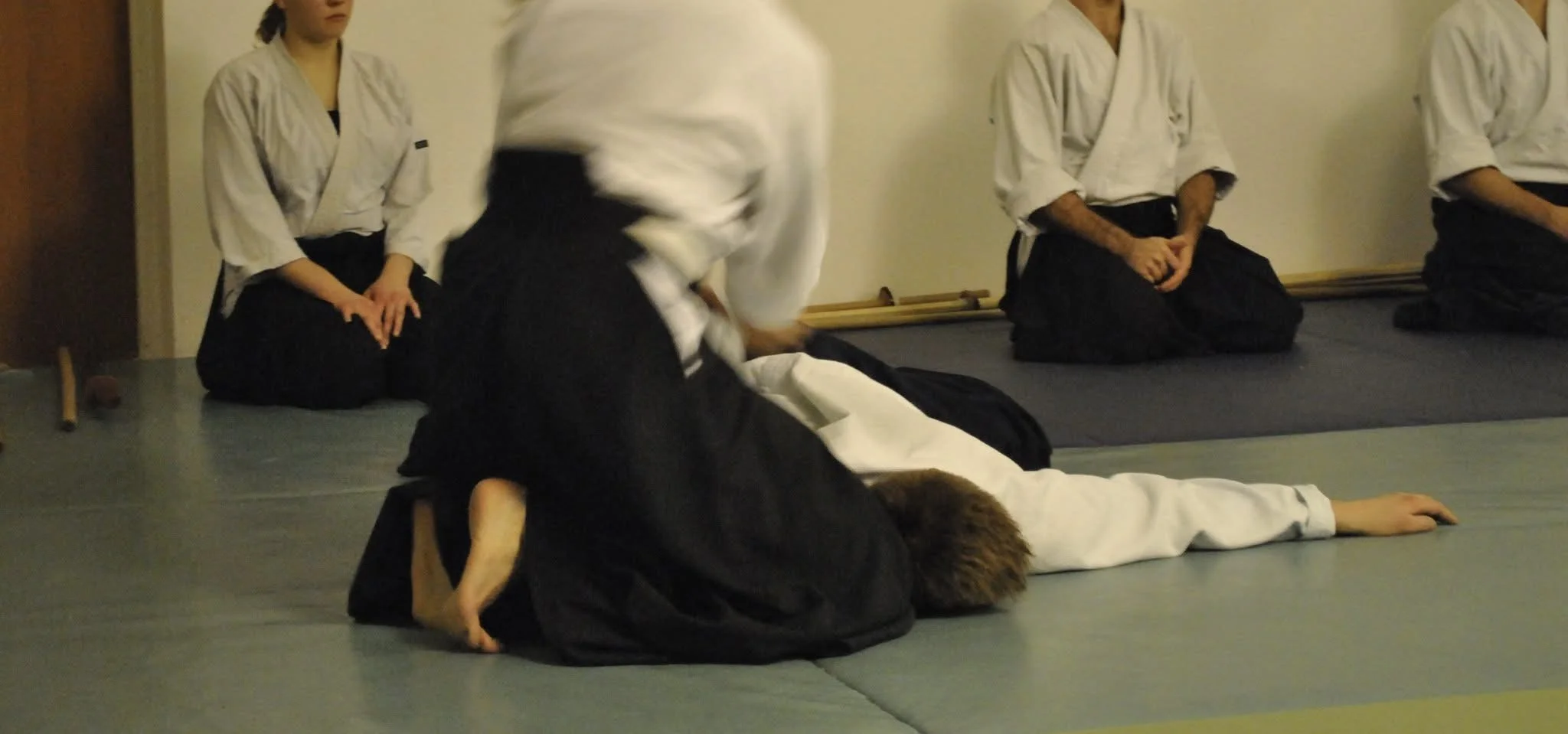
Dominika (in the foreground) wearing a Hakama during an Aikido training.